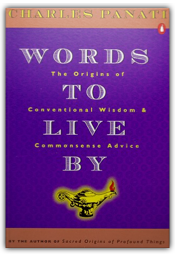

America's favorite expert on origins focuses on the roots and history of folk wisdom 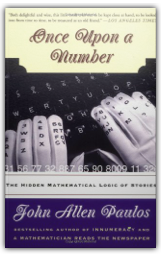
What two things could be more different than numbers and stories? Numbers are abstract, certain, and eternal, but to most of us somewhat dry and bloodless. Good stories are full of life: they engage our emotions and have subtlety and nuance, but they lack rigor and the truths they tell are elusive and subject to debate. As ways of understanding the world around us, numbers and stories seem almost completely incompatible.Once Upon a Number shows that stories and numbers aren’t as different as you might imagine, and in fact they have surprising and fascinating connections. The concepts of logic and probability both grew out of intuitive ideas about how certain situations would play out. Now, logicians are inventing ways to deal with real world situations by mathematical meansby acknowledging, for instance, that items that are mathematically interchangeable may not be interchangeable in a story. And complexity theory looks at both number strings and narrative strings in remarkably similar terms.Throughout, renowned author John Paulos mixes numbers and narratives in his own delightful style. Along with lucid accounts of cutting-edge information theory we get hilarious anecdotes and jokes; instructions for running a truly impressive pyramid scam; a freewheeling conversation between Groucho Marx and Bertrand Russell (while they’re stuck in an elevator together); explanations of why the statistical evidence against OJ Simpson was overwhelming beyond doubt and how the Unabomber’s thinking shows signs of mathematical training; and dozens of other treats. This is another winner from America’s favorite mathematician. 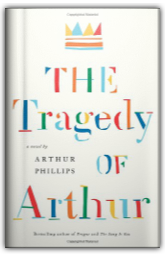
The Tragedy of Arthur is an emotional and elaborately constructed tour de force from bestselling and critically acclaimed novelist Arthur Phillips, “one of the best writers in America” (The Washington Post). 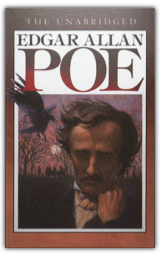
These hefty collections of favorite authors feature their best work, reset from the original first editions that were approved by the authors themselves. 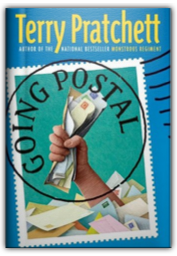
Arch-swindler Moist Van Lipwig never believed his confidence crimes were hanging offenses — until he found himself with a noose tightly around his neck, dropping through a trapdoor, and falling into ... a government job? 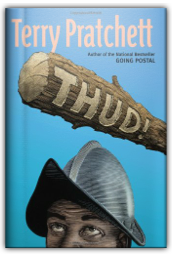
Once, in a gods-forsaken hellhole called Koom Valley, trolls and dwarfs met in bloody combat. Centuries later, each species still views the other with simmering animosity. Lately, the influential dwarf, Grag Hamcrusher, has been fomenting unrest among Ankh-Morpork's more diminutive citizens—a volatile situation made far worse when the pint-size provocateur is discovered bashed to death . . . with a troll club lying conveniently nearby. |
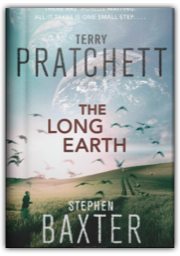
The possibilities are endless. (Just be careful what you wish for. . . .) 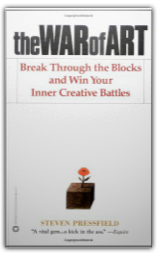
The Art of War meets "The Artist's Way" in this no-nonsense, profoundly inspiring guide to overcoming creative blocks of every kind. 
In the mid-1960s, the publication of Pynchon's V and The Crying of Lot 49 introduced a brilliant new voice to American literature. Gravity's Rainbow, his convoluted, allusive novel about a metaphysical quest, published in 1973, further confirmed Pynchon's reputation as one of the greatest writers of the century. 
The highly original satire about Oedipa Maas, a woman who finds herself enmeshed in a worldwide conspiracy, meets some extremely interesting characters, and attains a not inconsiderable amount of self knowledge. 
Spanning the period between the Chicago World's Fair of 1893 and the years just after World War I, this novel moves from the labor troubles in Colorado to turn-of-the-century New York, to London and Gottingen, Venice and Vienna, the Balkans, Central Asia, Siberia at the time of the mysterious Tunguska Event, Mexico during the Revolution, postwar Paris, silent-era Hollywood, and one or two places not strictly speaking on the map at all. 
The honeymoon with digital technology is over: millions of users are tired of having to learn huge, arcane programs to perform the simplest tasks; fatigued by the pressure of constant upgrades, and have had enough of system crashes. In The Humane Interface, Jef Raskin — the legendary, controversial creator of the original Apple Macintosh project — shows that there is another path. Raskin explains why today's interface techniques lead straight to a dead end, and offers breakthrough ideas for building systems users will understand — and love. Raskin reveals the fundamental design failures at the root of the problems so many users experience; shows how to understand user interfaces scientifically and quantitatively; and introduces fundamental principles that should underlie any next-generation user interface. He introduces practical techniques designers can use to improve their productivity of any product with an information-oriented human-machine interface, from personal computers to Internet appliances and beyond. The book presents breakthrough solutions for navigation, error management, and more, with detailed case studies from Raskin's own work. For all interface design programmers, product designers, software developers, IT managers, and corporate managers. 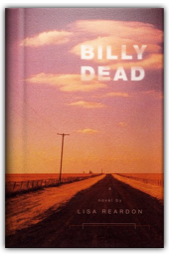
In an everyday voice, still as the air before thunder, Billy Dead introduces Ray Johnson and his kin. In their small Michigan town, the Johnsons are the family that starts all the trouble, has all the hard luck, and fuels all the gossip. Ray's older brother Billy has just been found murdered—by someone who watched him crawl a mile down the road, head bloody; who smoked four Marlboros while watching Billy die. The question isn't who killed him, but who didn't want him dead. Now Ray—knotted up with sorrow and a strange relief—bears the weight of the town's curious gaze as they dredge up all the past he's been trying to live down. But Ray insists on telling his own story, one of shameful abuse transfigured by impossible love: shocking, violent, tender, and redemptive in ways we have never known before. Lisa Reardon reshapes the American landscape of Annie Dillard's The Living and Peter Matthiessen's Killing Mr. Watson in this novel of shocking depths and soaring heights—and Ray Johnson emerges as one of the most heartrending and endearing characters in recent literature. |

Jack Baty
Collection Total:
256 Items
256 Items
Last Updated:
Dec 9, 2012
Dec 9, 2012

 Made with Delicious Library